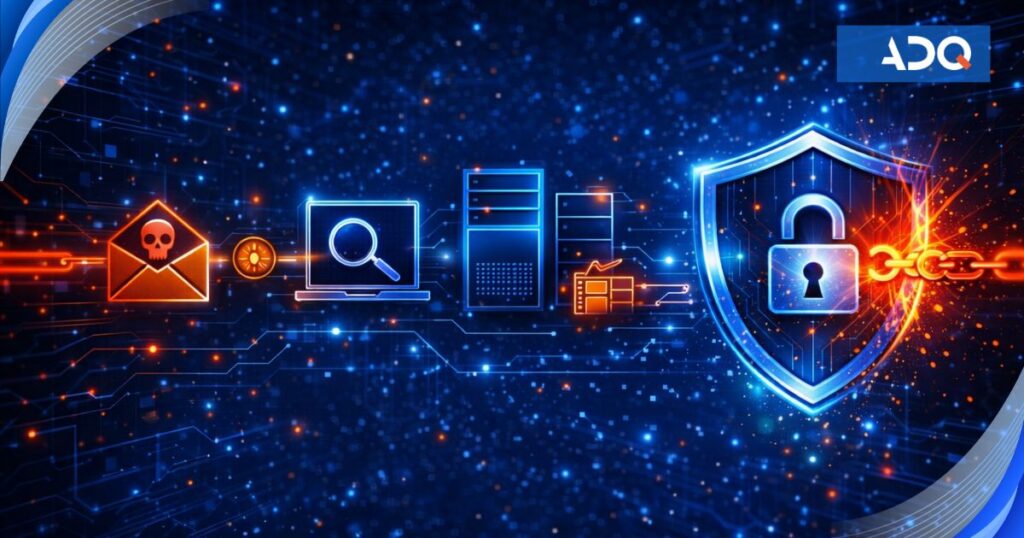
Many companies still view a cyberattack as a single event: a clicked link, an infected computer, or an encrypted server. In reality, a successful attack usually unfolds in stages. First, the attacker gathers information about the organization, then prepares tools, delivers the payload, exploits a vulnerability, establishes a foothold, communicates with the control infrastructure, and only at the end achieves their objective. This way of thinking is organized by the Cyber Kill Chain model, which describes an attack as a process consisting of successive phases.
This approach has significant practical value. It allows us to view an incident not only through the lens of the outcome, but above all through the lens of the path the attacker took to achieve that outcome. If an organization understands this sequence, it can more easily identify vulnerabilities and the moment when security measures failed.
Equally important, this model supports a layered approach to security, in which different defense mechanisms can stop an attack at various stages.
The biggest mistake in cybersecurity is reacting only after the damage is already visible. By the time a company notices data encryption, loss of access to systems, or a data breach, the attack is usually already in its final stages. A far better strategy is to disrupt the attacker’s activities earlier: during the reconnaissance phase, delivery phase, exploitation of vulnerabilities, or attempts to communicate with the command-and-control server. That is precisely when an organization has the best chance of limiting the scale of losses.
That is why modern security cannot rely solely on a single tool. A combination of controls is needed: email filtering, endpoint protection, updates, network monitoring, behavioral analysis, segmentation, and event visibility. Each of these layers can break a different part of the attack chain. In practice, this means that a company doesn’t have to be perfect everywhere. However, it must be able to stop the attacker early enough.
In practice, the Cyber Kill Chain effectively explains the purpose of security services that companies implement in stages. If the threat begins with an email inbox, a suspicious file, or an endpoint compromise, protecting workstations, servers, and mobile devices—along with rapid anomaly detection—becomes critical. If the attack attempts to progress further, the importance of traffic monitoring, network event visibility, log analysis, and 24/7 response increases. And when an attacker attempts to maintain a foothold in the environment and move laterally, segmentation, access control, and rapid isolation of the compromised resource are decisive.
This is precisely where the attack model intersects with ADQ’s approach. 24/7 monitoring, endpoint protection, network control, event analysis, and response support are not a collection of random services. They form a logical system designed to increase the likelihood of detecting an attack at the earliest possible stage. From a business perspective, this is a key difference. The goal is not merely to “have security measures in place,” but to stop the attacker’s actions before they lead to downtime, a data breach, or the encryption of the infrastructure.
For executives and business owners, the most important question today is not: do we have a firewall, EDR, or backup. The more important question is: at what stage of an attack can we actually respond. If the response only comes after the final outcome of the incident, the organization is acting too late. However, if it can detect reconnaissance, block the delivery of the payload, notice unusual behavior on a workstation, or cut off communication with the criminal infrastructure, it effectively reduces the risk of serious losses.
That is why the Cyber Kill Chain remains a useful framework for thinking about defense. It teaches us that a cyberattack does not begin with a catastrophe. It begins much earlier. And this means that a company can also act earlier—provided it has visibility, procedures, and a partner capable of responding before an incident becomes a crisis.